
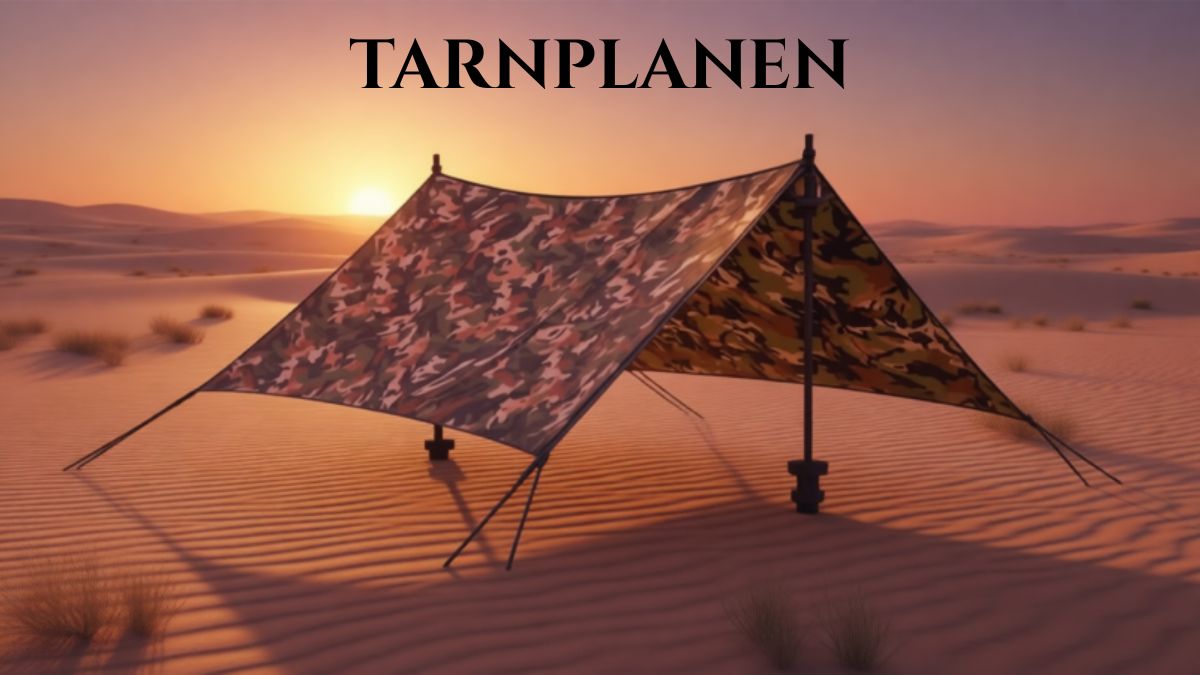
Tarnplanen—a German word that literally translates to “camouflage covers” or “camouflage tarps”—are specialized textiles designed to conceal objects, vehicles, equipment, or even personnel from visual detection. Though the term originates from German military usage, tarnplanen have evolved over time to serve a wide range of applications, both in defense and in everyday civilian life. At first glance, they may look like ordinary tarps or nets, but their construction, patterning, and material properties give them unique functional advantages. Unlike generic tarps, tarnplanen are engineered not just for weather protection but for visual deception—breaking up outlines, mimicking natural surroundings, and reducing shadows and shine.
Historically, the concept emerged during wartime, when armies needed reliable methods to hide supplies and installations from enemy reconnaissance—especially aerial surveillance. Early versions were simple drapes made from canvas or hessian, dyed in earthy tones. As warfare technology advanced, so did the sophistication of camouflage, and tarnplanen adapted accordingly. Today, they are a critical part of modern tactical gear, outdoor survival kits, and even photography and filmmaking setups where realistic concealment is needed.
Let’s delve deeper into the history, design, applications, and evolving role of tarnplanen in both professional and recreational contexts.
Table of Contents
A Brief History of Tarnplanen
The roots of tarnplanen trace back to the late 19th and early 20th centuries, particularly during World War I and World War II, when camouflage became a formal military discipline. The German armed forces—first the Imperial German Army and later the Wehrmacht—were among the pioneers in developing systematic camouflage doctrine. They introduced standardized patterns and field manuals for concealment tactics. By the 1930s, Tarnplanen were already in documented use, often deployed over artillery positions, trucks, and command posts.
During WWII, German Tarnplanen were typically made from heavy cotton twill or canvas, printed with disruptive patterns such as Splittertarn (splinter camouflage) or Sumpftarn (marsh camouflage). These patterns used sharp, angular shapes and contrasting colors to confuse the human eye—a principle known as “disruptive coloration.” The tarps weren’t just draped loosely; they were suspended on frames or poles to prevent telltale outlines and to allow air circulation, reducing shine and condensation.
Post-war, many NATO and Warsaw Pact countries continued developing camouflage textiles, leading to lighter, more durable materials like nylon and polyester. Modern tarnplanen are often reversible, with different patterns on each side—say, woodland on one side and desert on the other—enabling adaptation to varied environments. While originally a military asset, these tarps gradually entered civilian markets, appealing to hunters, wildlife photographers, preppers, and outdoor adventurers.
It’s important to note that while tarnplanen has strong German military heritage, the concept itself is universal. Many nations have equivalents—such as the U.S. “camouflage netting systems” or Russian “maskirovka coverings”—but the German term remains widely recognized in tactical and survivalist communities.
How Tarnplanen Are Designed and Constructed
Modern tarnplanen are more than just printed fabric. Their effectiveness depends on multiple design elements working together: color, pattern, texture, material, and structural deployment. Let’s unpack each of these components.
The color palette of a tarnplanen is never arbitrary. It’s carefully chosen to match specific seasonal or geographic conditions. For instance, Central European forest environments might use greens, browns, and muted grays, while arid regions require tans, ochres, and pale yellows. Some high-end tarnplanen even incorporate infrared-reflective (IRR) dyes to reduce detection by night-vision or thermal-imaging devices—an essential feature in modern combat zones.
Patterns, meanwhile, are mathematically designed. They avoid symmetry and repetition, using fractal-like irregular shapes that mimic natural textures: leaf clusters, rock formations, or dappled shadows. Digital camouflage—popularized in the 2000s—employs pixelated micro- and macro-patterns to work effectively at multiple distances. Traditional tarnplanen, however, often favor organic, hand-drawn motifs for a more natural appearance at close range.
Material choice affects durability, weight, and stealth. Early versions used cotton duck or hessian, which were biodegradable but prone to rot and mildew. Today’s tarnplanen are typically made from ripstop nylon or polyester, often coated with polyurethane (PU) or silicone for water resistance. Some models feature a “lofted” construction—layers of netting with fabric scrim and 3D foliage attachments—to create depth and break up the silhouette more convincingly.
Deployment technique is equally important. A well-designed tarnplanen hung flat against a surface can still betray its presence through unnatural shadows or wind-induced fluttering. That’s why military manuals emphasize using support frames, poles, or natural branches to create an irregular, non-reflective canopy. Grommets, reinforced corners, and edge webbing allow for secure anchoring without tearing.
| Feature | Traditional Tarnplanen (1940s) | Modern Tarnplanen (2020s) |
|---|---|---|
| Material | Cotton canvas, hessian | Ripstop nylon, polyester with PU/silicone coating |
| Pattern Type | Splittertarn, Sumpftarn (hand-printed) | Digital, multi-scale, reversible patterns |
| Weight | Heavy (1.5–3 kg/m²) | Lightweight (200–600 g/m²) |
| IR Signature | High (visible to NVGs) | Low (IRR-treated for reduced IR reflectance) |
| Add-ons | None (basic tarp) | 3D foliage, modular attachment points, flame-retardant options |
Where and How Tarnplanen Are Used Today
While military applications remain central to tarnplanen development, their utility has expanded significantly beyond the battlefield.
Military & Law Enforcement
In armed forces worldwide, tarnplanen shield critical assets: radar units, communication hubs, armored vehicles, and forward observation posts. They’re part of larger concealment systems that may include decoys, thermal blankets, and multispectral smoke. Special forces often use compact, lightweight tarnplanen for temporary hides or sniper blinds—sometimes combining them with local vegetation for total integration.
Police tactical units (e.g., SWAT) also employ tarnplanen during surveillance or hostage rescue prep, especially in urban settings where visual stealth is as vital as noise discipline.
Hunting & Wildlife Observation
Hunters have long borrowed military techniques, and tarnplanen are now staple gear for bowhunters and spot-and-stalk practitioners. A well-placed tarnplanen can serve as a ground blind, tree blind cover, or decoy shield. Wildlife photographers use them similarly—creating hidden hides that don’t disturb animal behavior. Because many tarnplanen are scent-free or treated with odor-neutralizing coatings, they’re ideal for close-range encounters with sensitive species like deer or waterfowl.
Outdoor Recreation & Survival
Campers and bushcraft enthusiasts appreciate tarnplanen for their dual role: shelter and concealment. In survival scenarios, staying unseen can be as important as staying dry. A tarnplanen can be rigged as a lean-to, debris shelter overlay, or emergency signal cover (by flipping to a bright side if needed). Their durability and resistance to UV degradation make them more reliable than standard tarps in extended wilderness use.
Film, Theater, and Photography
Production designers use tarnplanen to hide equipment, lighting rigs, or crew members during outdoor shoots. Their naturalistic textures blend seamlessly into forest or field backdrops. In theater, they provide quick, portable set dressing for “wilderness” scenes.
Civil Defense & Emergency Response
During disaster relief operations, tarnplanen can screen triage zones or supply depots—especially in conflict-adjacent areas where visibility could attract unwanted attention. Their quick-deploy nature makes them ideal for rapid-response concealment.
Choosing the Right Tarnplanen: Key Considerations
Not all tarnplanen are created equal, and selecting the best one depends on your specific needs. Here are several factors to weigh before purchasing:
- Environment: Match the pattern to your primary terrain—woodland, desert, snow, or urban. Some premium tarnplanen are reversible (e.g., green/brown on one side, tan/gray on the other), offering flexibility.
- Size and Weight: A small 2×3 m tarnplanen suffices for a solo hide, while vehicle concealment may require 6×8 m or modular panels. Backpackers prioritize ultralight options (<500 g), whereas base-camp users may prefer heavier-duty versions.
- Material Properties: Look for ripstop construction, waterproof rating (measured in mm H₂O), UV resistance, and flame retardancy if needed. Military-spec tarnplanen often meet standards like MIL-C-44423 or STANAG 2057.
- Attachment System: Grommets should be brass or reinforced plastic. Webbing loops, cord locks, and MOLLE/PALS-compatible straps add modularity.
- Multispectral Performance: If operating where night vision or thermal imaging is a concern, seek tarnplanen labeled “IRR-compliant” or “low-IR signature.”
Reputable brands—both military suppliers and outdoor manufacturers—now offer civilian-grade tarnplanen with near-tactical performance at accessible prices. Always check independent field reviews before committing, as advertised specs don’t always reflect real-world behavior (e.g., how much the fabric flutters in wind or fades after sun exposure).
Common Myths and Misconceptions About Tarnplanen
Despite their growing popularity, several misunderstandings persist about tarnplanen:
Myth 1: “Tarnplanen make you invisible.”
Reality: No camouflage guarantees invisibility. Tarnplanen reduce detection range and delay recognition—but movement, noise, and silhouette management are equally critical.
Myth 2: “Digital camo is always better than traditional.”
Reality: Digital patterns excel at medium-to-long distances, but organic, large-scale patterns often perform better up close in natural settings. The best tarnplanen combine both principles.
Myth 3: “Any green tarp is a tarnplanen.”
Reality: True tarnplanen use scientifically developed patterns, precise color calibration, and specialized materials. A dyed tarp lacks the disruption and texture needed for effective concealment.
Myth 4: “Tarnplanen are only for soldiers.”
Reality: As shown earlier, their applications span hunting, photography, camping, filmmaking, and more.
Final Thoughts
Tarnplanen represent more than just camouflage tarps—they’re a fusion of art, science, and practical ingenuity. From their origins in wartime necessity to their modern-day roles in conservation, recreation, and security, tarnplanen continue to prove their enduring value. Whether you’re a soldier on patrol, a photographer tracking elusive wildlife, or a camper seeking a discreet shelter, a well-chosen tarnplanen can make all the difference.
Understanding their design, respecting their limitations, and using them thoughtfully unlocks a level of stealth and preparedness few other tools can match. And as technology progresses, the humble tarnplanen—that unassuming sheet of patterned fabric—will likely remain a cornerstone of concealment strategy for decades to come.
The Future of Tarnplanen: Smart Textiles and Adaptive Camouflage
Looking ahead, tarnplanen are poised for high-tech evolution. Researchers are exploring “smart” adaptive camouflage—fabrics that change color or pattern in real time using thermochromic inks, electroluminescent panels, or even micro-camera/projector systems (though the latter remain experimental).
Other innovations include:
- Nano-coatings that repel dirt, water, and infrared signatures simultaneously
- Biodegradable tarnplanen for eco-conscious militaries and hunters
- Integrated solar panels for powering field equipment under concealment
- AI-assisted pattern generation, optimized for local terrain via satellite data
While these may sound like science fiction, prototypes already exist. In the near term, expect hybrid tarnplanen—tactical yet sustainable, lightweight yet robust, analog yet enhanced with digital features.
Frequently Asked Questions (FAQs)
Q: Can I wash my tarnplanen?
A: Yes—but gently. Hand-wash in cold water with mild, scent-free detergent. Avoid bleach, fabric softeners, and dryers, as heat can degrade coatings and IRR treatments. Air-dry in shade.
Q: Do tarnplanen work in all seasons?
A: Some do. Reversible or modular tarnplanen can adapt (e.g., flip to snow side in winter), but dedicated seasonal models offer optimal performance. Always match pattern to current foliage and ground cover.
Q: Are tarnplanen legal for civilians to own?
A: In most countries—including the U.S., Canada, UK, and EU nations—yes. Tarnplanen are unregulated as they’re considered general-purpose textiles. However, local laws regarding camouflage clothing (e.g., in some African nations) may differ—always verify.
Q: How long does a tarnplanen last?
A: With proper care, high-quality tarnplanen can last 5–10 years of regular use. UV exposure is the biggest enemy; storing it dry and out of sunlight extends lifespan.
Q: Can I make my own tarnplanen?
A: DIY versions are possible using camouflage fabric and grommets—but matching military-grade durability, IR performance, and pattern fidelity is extremely difficult. For critical uses, factory-made is recommended.