
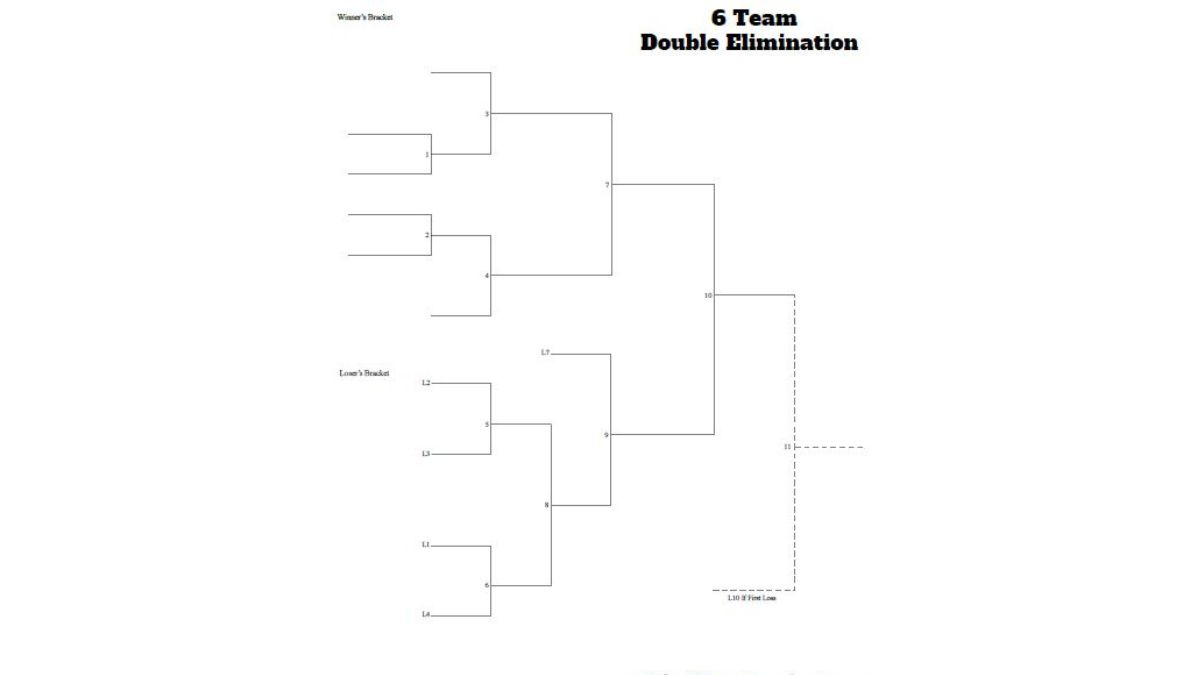
Organizing a tournament can be both exciting and challenging, especially when ensuring fairness and giving every team a fighting chance. A 6 team double elimination bracket is an ideal format for competitions where each team should have the opportunity to recover from an initial loss while maintaining competitive integrity. Unlike single elimination tournaments, where one loss can mean immediate elimination, a double elimination bracket allows teams to lose once and still remain in contention. This format not only increases the total number of games but also offers a more accurate reflection of team skill and consistency.
Table of Contents
What is a 6 Team Double Elimination Bracket?
A 6 team double elimination bracket is a tournament structure designed for six competing teams, where a team is only eliminated after losing two matches. This setup creates two separate paths: the winner’s bracket and the loser’s bracket. Teams that continue to win remain in the winner’s bracket, while teams that lose once drop into the loser’s bracket. If a team loses in the loser’s bracket, they are eliminated from the tournament. This dual-path system ensures that a single upset does not immediately remove strong contenders, providing a fair and balanced competition.
How the Bracket Works
In a 6 team double elimination bracket, the first round typically involves the top two seeds receiving a bye, while the remaining four teams compete in two initial matches. This ensures that higher-ranked teams are rewarded for past performance or seeding, creating a balanced start to the tournament. As the bracket progresses, winners advance in the winner’s bracket, and losers enter the loser’s bracket, where they face elimination if defeated again. This structure continues until one team remains in each bracket, culminating in a grand final where the winner of the loser’s bracket must defeat the winner of the winner’s bracket twice to claim the championship.
To visualize the flow, consider the following match setup table:
| Round | Winner’s Bracket Match | Loser’s Bracket Match | Notes |
|---|---|---|---|
| 1 | Team 3 vs Team 6 | N/A | Teams 1 and 2 get a bye |
| 1 | Team 4 vs Team 5 | N/A | Losers move to the loser’s bracket |
| 2 | Team 1 vs Winner 1 | Loser 1 vs Loser 2 | Loser of the match in loser’s bracket eliminated |
| 2 | Team 2 vs Winner 2 | N/A | Winner advances in winner’s bracket |
| 3 | Winner 3 vs Winner 4 | Loser 3 vs Winner LB | Continues until only two teams remain |
| Final | Winner WB vs Winner LB | N/A | Loser bracket team must win twice |
This table demonstrates how a 6 team double elimination bracket balances fairness with competitive intensity. Each team gets at least two matches, and the path to the championship is transparent.
Advantages of a 6 Team Double Elimination Bracket
The 6 team double elimination bracket has several notable advantages. Firstly, it reduces the impact of a single poor performance, allowing strong teams to recover and prove their abilities. Secondly, it increases the number of competitive games, which is beneficial for spectators, sponsors, and players alike. A greater number of games also allows teams to adapt strategies and improve performance over time. Additionally, this bracket style provides clear and organized scheduling, making it easier for tournament organizers to manage logistics such as game times, locations, and broadcasting.
Another advantage is its adaptability. The 6 team double elimination bracket can accommodate various sports and competitive games, including esports, basketball, soccer, and tennis. Its structure is scalable, meaning that it can be adjusted for larger or smaller tournaments while maintaining the principle of double elimination.
Key Strategies for Teams
Competing in a 6 team double elimination bracket requires careful planning and strategy. Teams should focus on consistent performance in the early rounds to remain in the winner’s bracket, reducing the number of high-pressure matches. Maintaining team morale is crucial, especially for teams that fall into the loser’s bracket. Recovery matches often carry significant stress, and teams that can manage mental toughness and adaptability often advance further. Preparation for potential back-to-back games is also essential, as teams in the loser’s bracket may have to play consecutive matches with minimal rest.
Understanding the opponent’s strengths and weaknesses can also provide a competitive edge. Since teams might meet multiple times throughout the tournament, analyzing prior matches can help adjust strategies effectively. Coaches and managers often emphasize endurance, focus, and tactical flexibility as essential components for success in a 6 team double elimination bracket.
Common Challenges
While a 6 team double elimination bracket has many benefits, it also presents challenges. Scheduling can become complicated, especially if matches in the loser’s bracket run longer than expected. Organizers must account for potential rematches and extended game durations. Additionally, teams in the loser’s bracket face the risk of fatigue due to playing more matches, which can impact performance in crucial games. Maintaining fairness in rest periods between matches is therefore critical to ensure competitive integrity.
Another challenge is communicating the bracket structure to participants and spectators. Since teams may re-enter the tournament after a loss, it can sometimes be confusing for casual viewers. Clear visuals, detailed match schedules, and regular updates are essential to enhance understanding and engagement.
Tips for Organizers
Organizers of a 6 team double elimination bracket should plan meticulously. Creating a visual bracket diagram helps everyone follow the tournament’s progress easily. Including clear instructions about match times, locations, and potential tiebreakers ensures smooth operations. Providing rest periods, especially for teams in the loser’s bracket, maintains fair play and prevents fatigue-related disadvantages. Recording match results promptly and updating the bracket consistently also avoids confusion. Digital bracket tools and software can simplify these tasks, especially in tournaments with live audiences or streaming components.
Conclusion
A 6 team double elimination bracket is an effective and fair method for organizing tournaments that balances competitive integrity with opportunity. It ensures that teams have a chance to recover from an early loss, encourages consistent performance, and increases the total number of competitive games. By understanding the structure, advantages, strategies, and challenges associated with this bracket type, teams and organizers can create an engaging, fair, and well-run competition. Whether for professional sports, esports, or recreational leagues, a 6 team double elimination bracket provides a dynamic and exciting tournament format that rewards skill, resilience, and strategic thinking.
FAQs
What is a 6 team double elimination bracket?
A 6 team double elimination bracket is a tournament format where each team must lose twice to be eliminated, providing a second chance after one loss.
How many matches are played in this bracket?
Typically, a 6 team double elimination bracket involves 10 to 11 matches, depending on whether the loser’s bracket team wins the first final match.
Why use a double elimination format?
Double elimination is used to ensure fairness, allowing teams to recover from one loss while maintaining competitive integrity.
Can this format be used for any sport?
Yes, this bracket works for various sports and competitive games, including esports, basketball, and tennis.
How should teams prepare?
Teams should focus on consistency, endurance, tactical flexibility, and mental toughness to succeed in a 6 team double elimination bracket.